

 Trade W
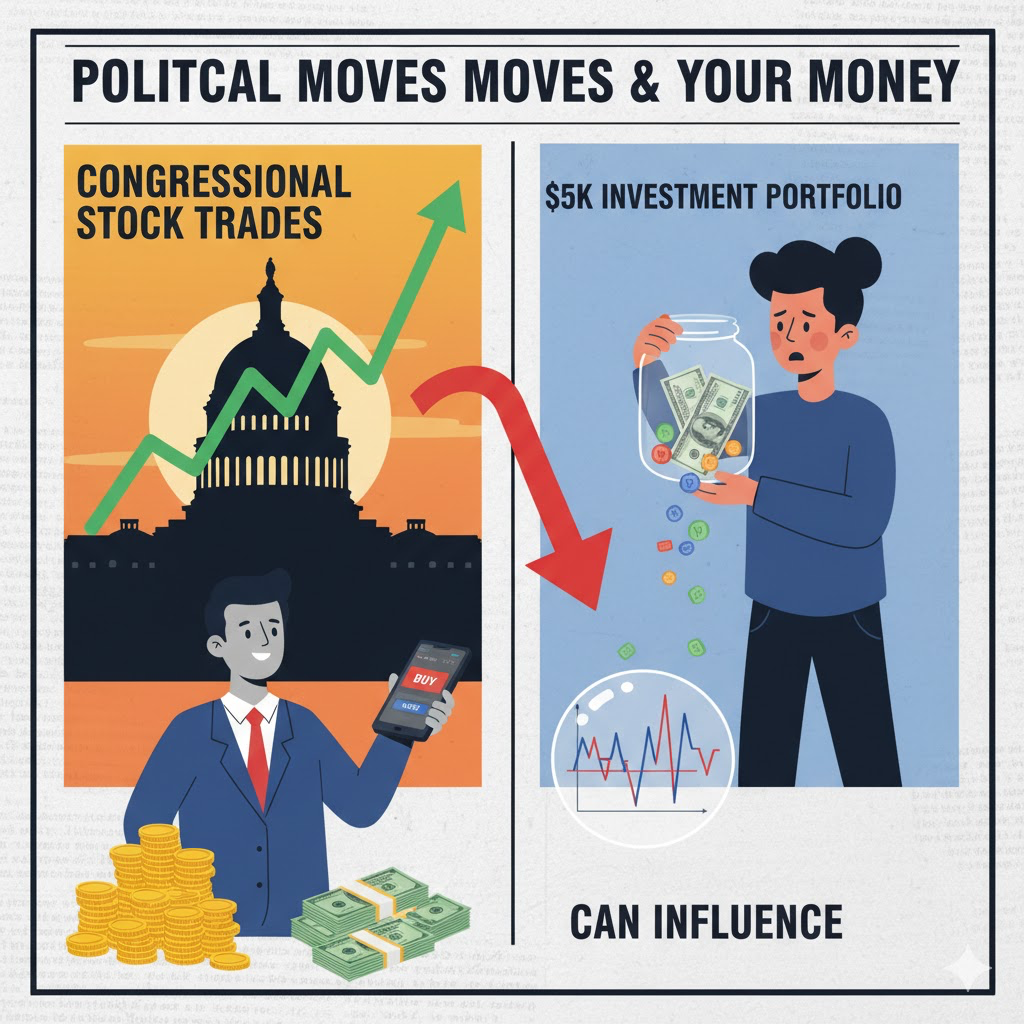
Why Congressional Stock Trades Matter to You
Here's something most average investors may not consider: politicians who are making decisions in Washington D.C. are also trading stocks. And, what happens to be on their buy and sell lists may provide very powerful insights into the direction of the markets.
For the past few years congressional activity in the markets has taken center-stage in financial news. From tech developments to energy trades, congressmen's trades provide early insights into lawmakers' sentiment to and intentions about the economy. It is not so much whether or not you should copy them, but rather whether or not their behavior is significant enough to be on your radar.
When a senator increases their position in an industry, they are often showcasing their confidence based on information they understand. You should at least take notice - although you may not want to act on it unless you bring context to it.
The good news is that all congressmen's trades are public record. The SEC legislatively mandates that congressmen disclose their trading activity, and is published on government site such as House.gov and Senate.gov. So, the information advantage that rich insiders once had is becoming more available to the likes of you. Now it's just a matter of knowing what to look for and whether or not you want to responsibly use the information.
How Congressional Stock Trading Actually Works
It is important to know the regulations governing this industry because it will help you identify signals from noise.
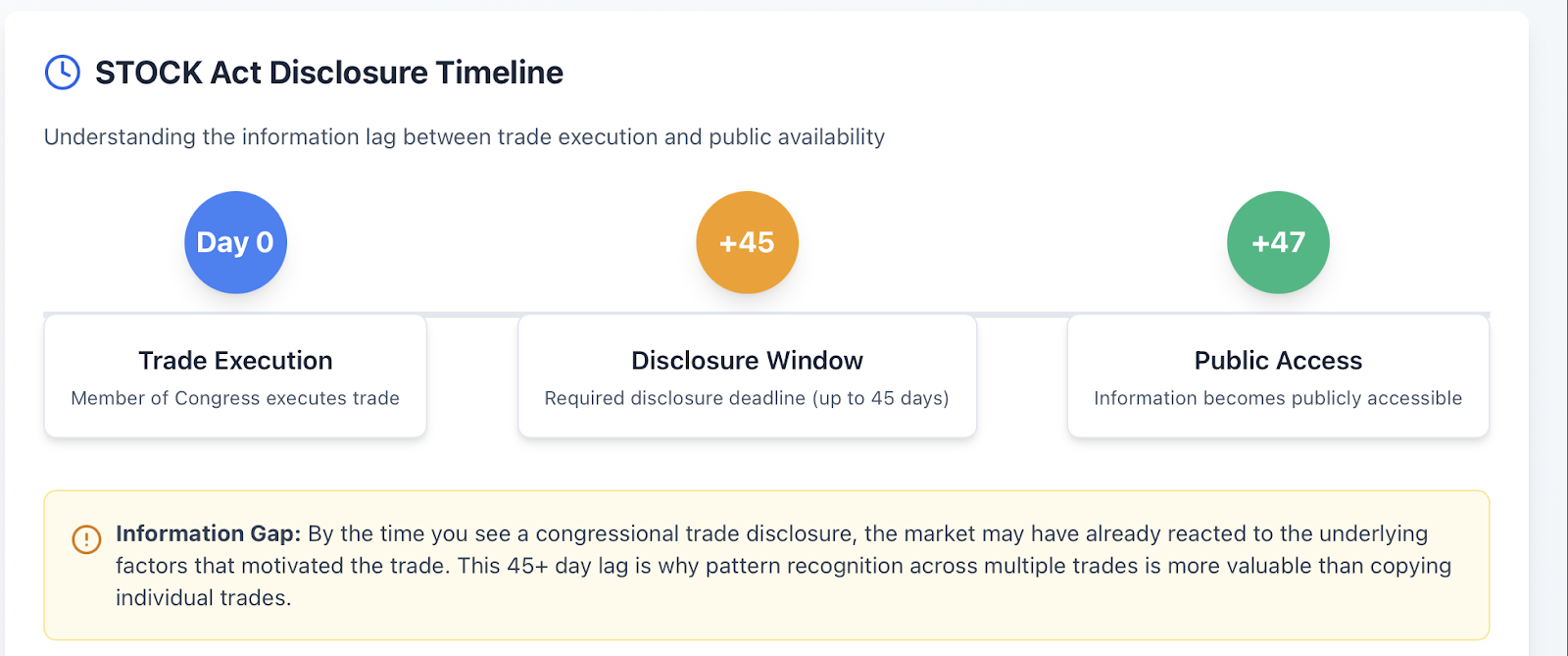
The STOCK Act was meant to call out this type of behavior. Passed in 2012, the Act requires members of Congress to disclose stock trades within 45 days (or 3 days if trading on certain platforms). No one is allowed to get an undeserved, sneaky, and illegal form of insider advantage in theory, but in practice, certain gaps exist.
Some members use blind trusts or trade stocks through certain family members to avoid ethical red flags, and then they cannot be told what the trust owns. In this sense, the member does not even know what he's owned for an unknown period of time. Other members create corporate accounts confusing to the average audit of the ownership structure. Yes, these members file disclosure forms, but they can't be understood without a detective.
The SEC and Office of Congressional Ethics (OCE) may review the disclosures for violations, but there is no guarantee that all illegalities are captured and submitted for review. Various schemes and undisclosed delays for filing could allow certain trades to not be disclosed or inadvertently catch the attention of law enforcement. Disclosing expensive current trades is a good way for a member to disguise an entire market or trade that sells coincidence to the potential market and build off a current holder's value.
The important takeaway for your portfolio: there's a regulatory system in place, but there remains an informational gap. Policymakers have much deeper context about industries and changes to policies than the average investor. When policymakers trade, they are reacting based on that knowledge, even if the final trade is later announced.
What the Data Actually Shows
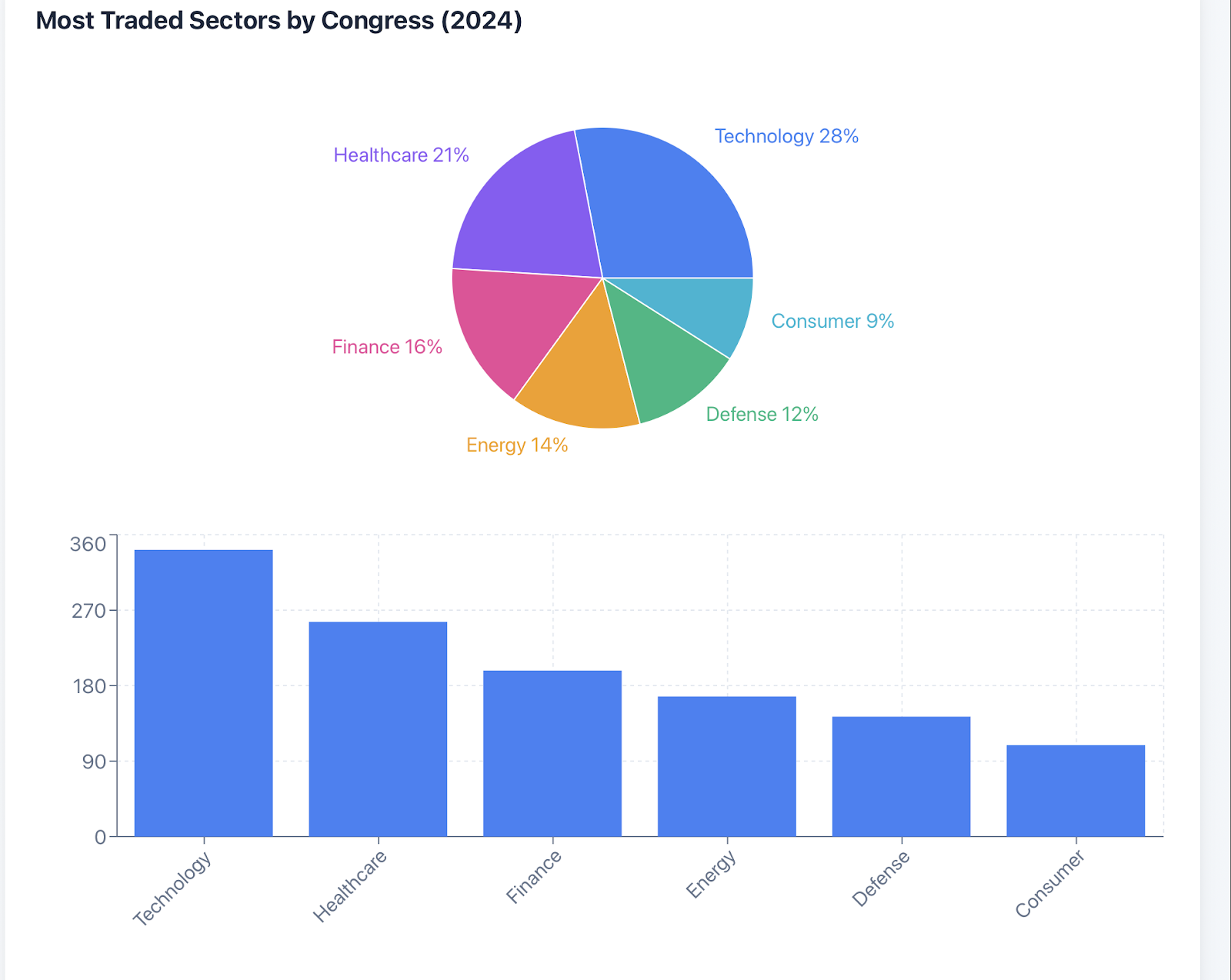
Research on congressional trading trends has shown that members of Congress do, on average, outperform the market. Data has shown patterns when evaluating stock performance before and after congressional trades. For example, we know that, where senators or representatives have increased their ownership positions in tech stocks, we have generally seen upward stock movement in the subsequent weeks and months. Similar movement occurs for energy stocks when members of specific committees increase their ownership in advance of an energy policy discussion.
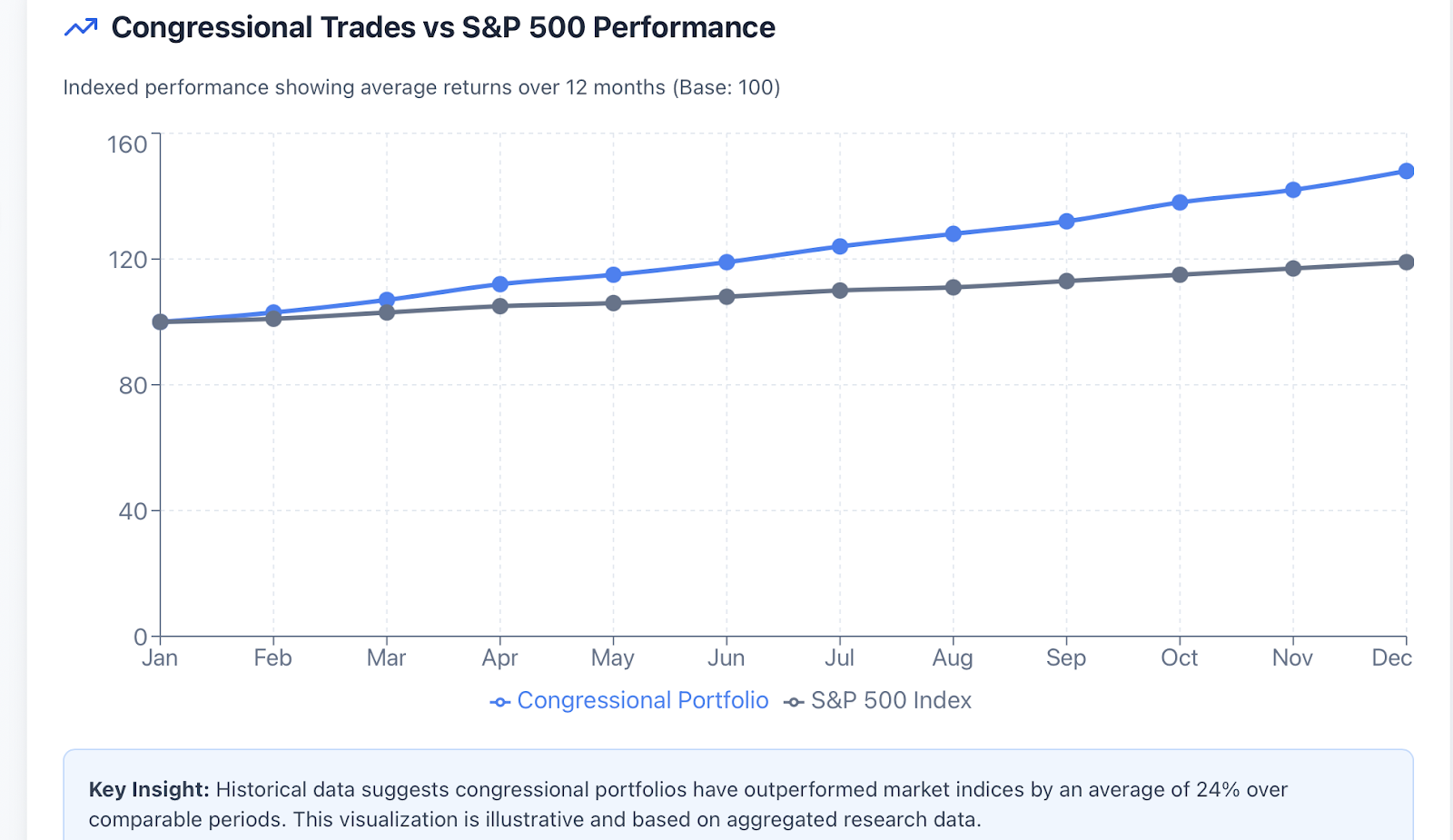
But correlation is not causation; sometimes Congress trades on a legitimate investment thesis (strong companies or sectors of growth) and sometimes the stock moved for other reasons altogether, and perhaps they had nothing to do with the congressional trade that occurred. Just because one trades in a company does not mean they started or influenced the movement by their trade.
What you can do, at a minimum, is create association for the movement of capital in one direction. Suppose you saw a number of legislators across multiple committees investing cash into renewable energy. In that case, you would most likely associate that movement with legislative momentum and, ultimately, confidence in the renewable energy industry. From the barometer of possible impending policy direction or market momentum, this movement would signal success for the new market confidence movement.
For example, if you saw defense contractors with aligned ownership from members of the Armed Services Committee, it would suggest you may know something is in consideration. Or, at least you would have a better assessed idea of what is in the pipeline by members of Congress' trading, and, for example, their influence on the recent proposed defense budget bill.
In review, the best practice is not to try and replicate a trade initiated in members of Congress' portfolios but look for the pattern and momentum of capital markets' trends being developed, often before it reaches the national media outlets. For example, when you see congressional activity upon aligning a macroeconomic context, it probably means you are receiving a signal from the industry analysis.
Smart Investment Strategies Using Congressional Trades as a Reference
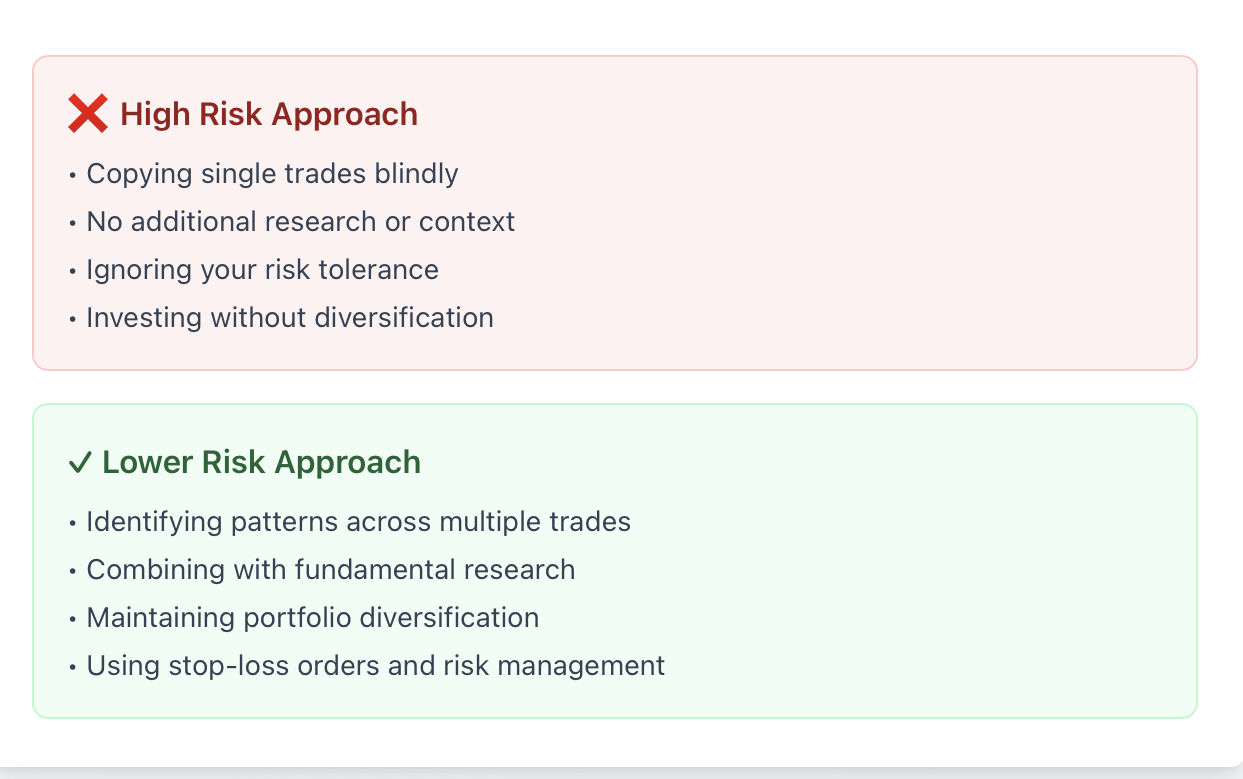
One useful method combines congressional activity with other research. Once you’ve observed congressional members adding positions in a specific industry, the next question is why? Look at the most recent earnings reports, news articles and perspective on the economic outlook in that industry around the next quarter or one year out. Is this making sense and aligned with what you’re identifying in congressional activity, or is this contrary to that?
Diversification is key here. You shouldn't invest your entire $5,000 into a stock because a senator is doing the same - unless your risk tolerance allows that. However, maybe yes, it is warranted tweaking your portfolio allocation, once you recognize a cadence of activity from congressional members in combination with your own research.
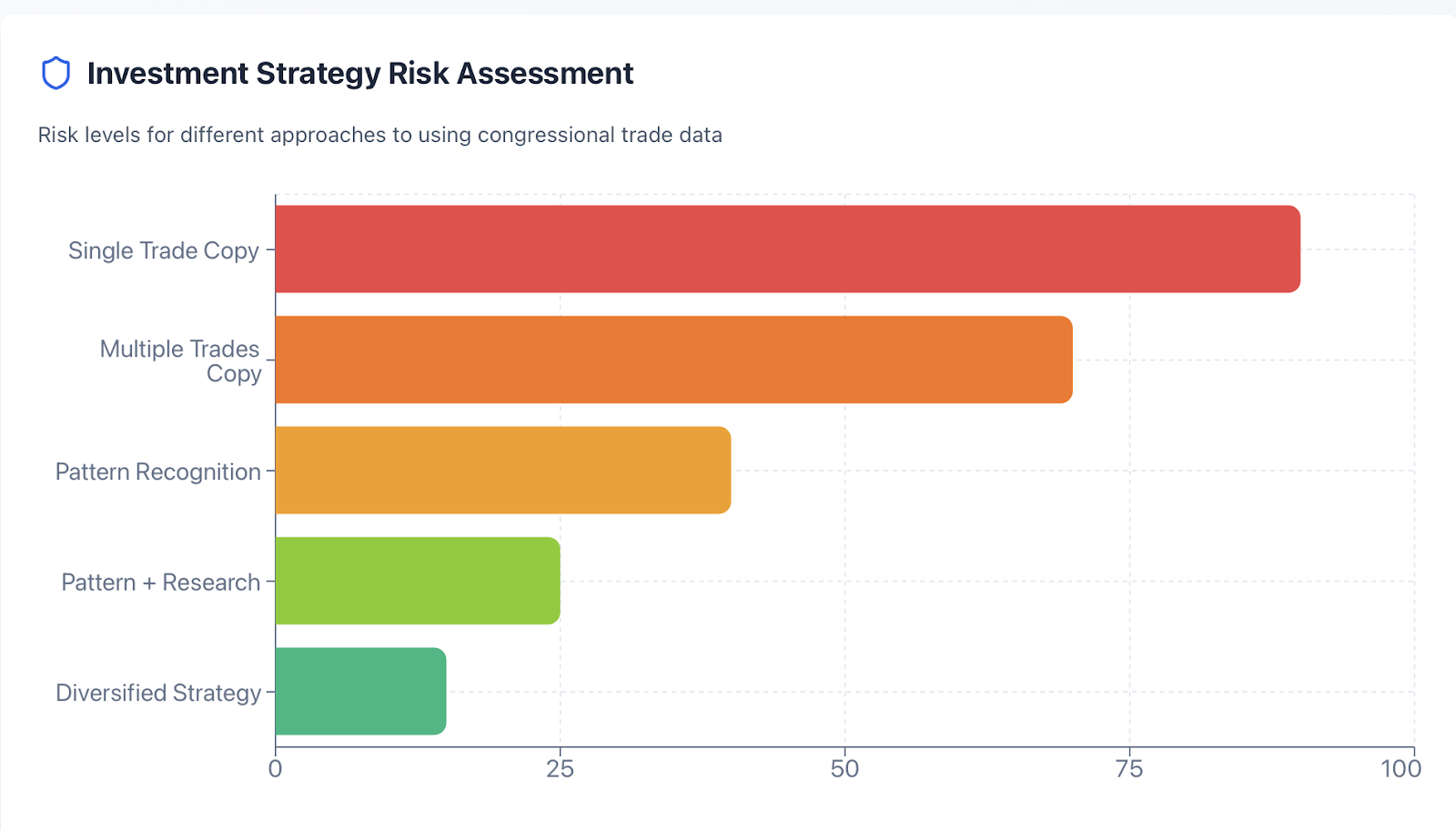
In other words, you notice the same tech names showing up in documents, agendas, forms, trade transactions, etc. Moreover, if allocating an additional 10-15% to that exposure makes sense to you based on your own reasonable cost/benefit analysis then perhaps that is more justifiable than going "all-in”.
Utilize real-world risk management techniques in conjunction with these research tools. For example, a stop-loss order can mitigate losses if you are invested in a stock that is affected by congressional activity but nonetheless declines in value. By diversifying your investment by time horizon (i.e., some short-term trades and some long-term trades) you can further mitigate risk in your trading.
The key is to treat congressional trades as an informational input, not a trading signal. Conduct your own analysis and make your decision based on your analysis of the relevant research, industry trends and economic conditions. Make your investment decisions based on your personal goals and risk tolerance and not based on someone inside of Washington making a purchase.
What Global Markets Teach Us
The European Union has a stricter disclosure system for EU Commission members than the United States, in some respects. For example, members must disclose trades within days, rather than weeks.
The transparency principle extends beyond just the members of the European Union to include other political officials and other classes of assets. Similarly, in Canada, there are legislation like this that applies, but the enforcement of these regulations may depend on your province or the Federal jurisdiction.
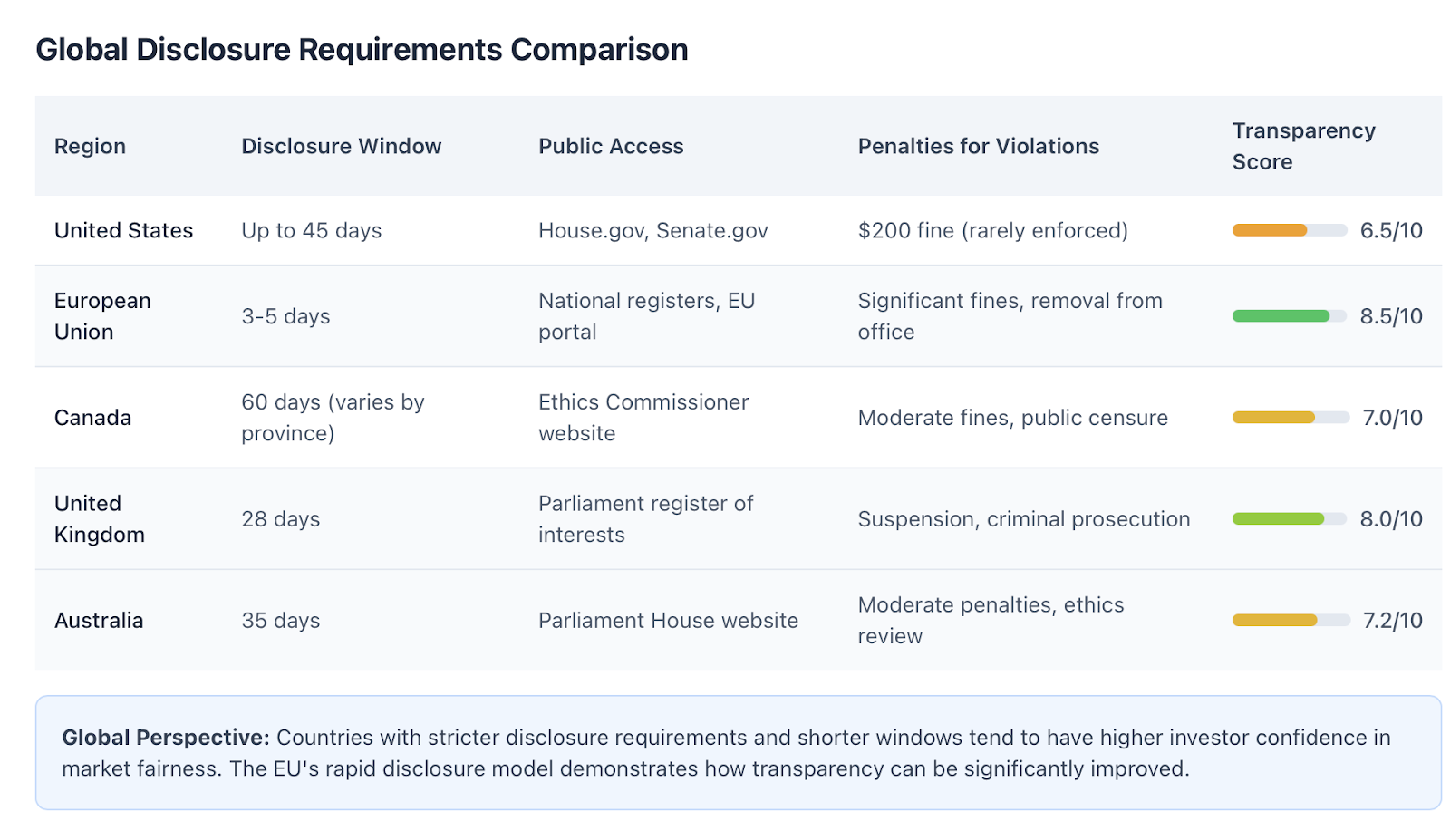
YET, what is fascinating is that countries with greater disclosure requirements have more the investors' faith in their market. When you know the rules and it's easy to access information, you can better invest with confidence.
This matters for American investors, because this is a nudge to improve according to other markets. While the United States has made improvements after taking action, we are not there yet. Other global markets can truly give insightful examples of what more rigidity in transparency can look like.
Of course, if you're an investor globally, the local political trading regulations should be considered when making decisions. A potentially good stock in the United States (or elsewhere), may not factor in the political insiders who influence the outcomes differently than the United States. Do your research on local rules.
Risks and Ethical Boundaries You Can't Ignore
Is it ethical to capitalize on public information, such as the stocks lawmakers are buying and selling? Most investors would concur, as long as what's being analyzed is being made available publicly, which is different from insider trading. Insider trading occurs when someone acts on nonpublic information. Since congressional disclosures are public, you are on legally safe ground.
That said, there are limitations. If you were ever privy to nonpublic congressmen information, on a private basis, from someone unofficially affiliated with Congress, you would be crossing into illegal insider trading. Don't go there. Stick to trades that are disclosed publicly.
There is a psychological risk involved. When you follow congressional trades, it is easy to establish some patterns which do not actually exist. Humans can develop unrelated patterns. There may be noise which leads you to believe a trend exists. You are better off confirming patterns with multiple signals before changing wealth in your portfolio.
Remember that congressmen make trades for many reasons. Even though some could be a true conviction of the market, some are simply a rebalance, or a settlement, through estate planning or a divorce settlement. You don't know so don't over analyze single trades. Analyzing trends would take into account the number of trades based on group clusters over time of activity as opposed to single trades or trends.
Start Investing With More Information
While trades made by Congress aren't a foretelling of market movements, it provides a data point to learn about. When trade data is used in conjunction with good research and a smart risk profile for a specific trade, you will be in a better informed position.
We encourage you to investigate the tools available to track and measure congressional trading activity to make it part of your research routine and investment process. Please visit Tradewill and learn how trading platforms with good data intelligence can help you identify opportunities faster and improve your risk profile.
Open a demo account and see how the professional-grade data can influence your money management and investment process.
Disclaimer: The content of the blog does not represent any position of Trade W, does not serve as any trading-related decision advice, and does not endorse any third-party.